
Global Differences in Menopause Onset
We talk about 51 as the average age of menopause (12 months with no period), but the truth? That’s the average in the US.
Zoom out to a global scale, and the average age of menopause differs meaningfully by years depending on where a woman lives, her ethnicity, and her socioeconomic circumstances.
I find this fascinating, not just as a clinician who works part time with a predominantly immigrant population, but also as someone who thinks a lot about what actually drives biological aging.
So let's talk about the numbers, and the theories behind them.
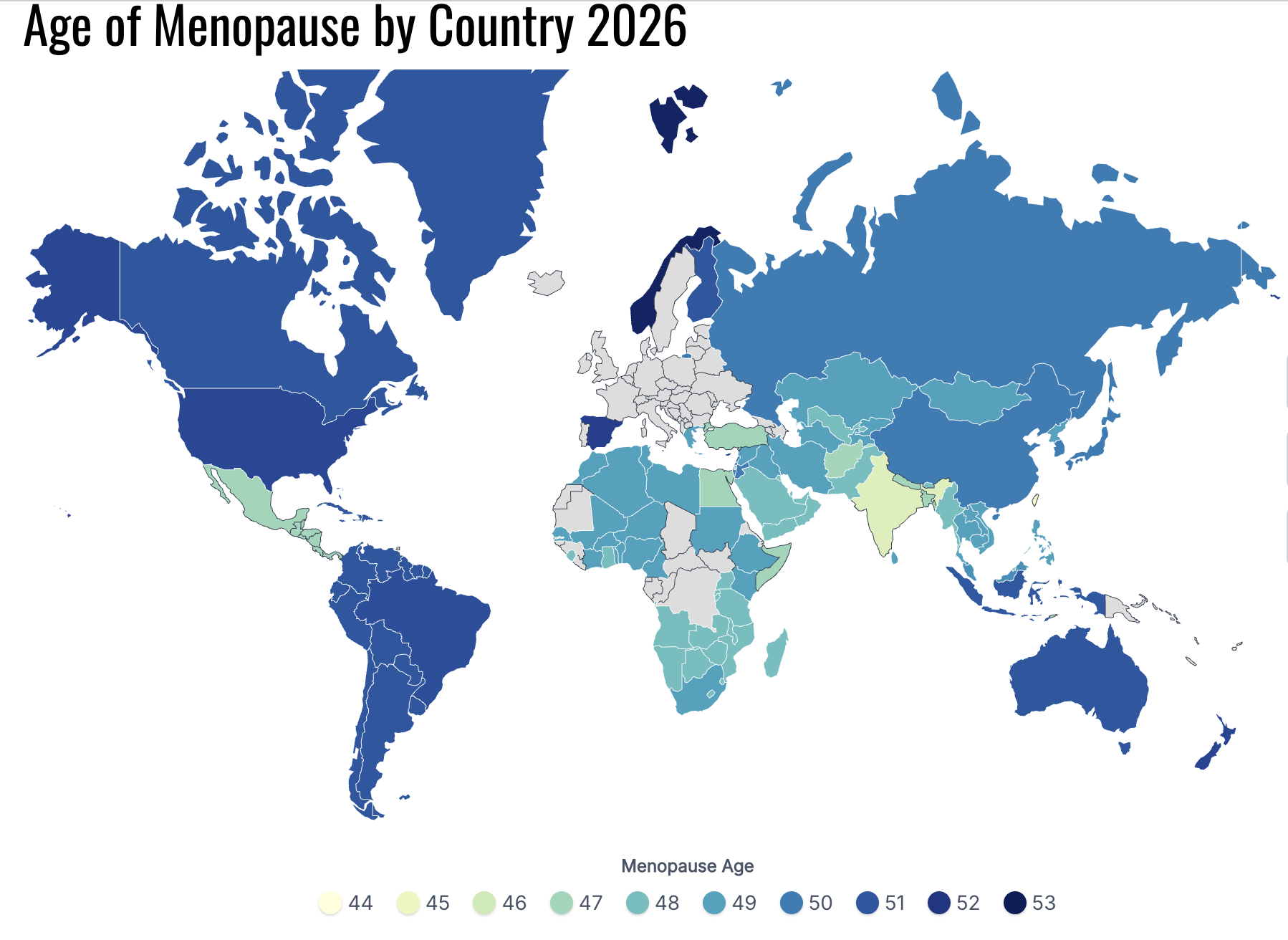
World Population Review (2026 data so far)
The global range
A large pooled analysis of over 234,000 postmenopausal women from 17 studies across 7 countries found the median age at natural menopause to be 50.0 years globally. A systematic review and meta-analysis of 46 studies across 24 countries reported a mean age of 48.8 years. But country- and region-level data tells a much wider story.
On the later end:
Norway has seen a notable upward trend, with mean age at menopause rising from about 50.3 years in women born in the late 1930s to approximately 52.7 years in women born in the early 1960s
Australia, Papua New Guinea, and Indonesia average around 51 years
Europe overall ranges from about 50 to 53 years
The US averages around 51 years, though NHANES data show the mean has increased from 48.4 years in 1959–1962 to 49.9 years in 2015–2018
China, Japan, and South Korea average around 50 years
On the earlier end:
India averages approximately 46–47 years
Central America ranges from 44 to 47 years depending on the country
Middle East ranges from 47 to 49 years
Northern African countries average around 49 years, while Subsaharan countries range slightly earlier 47-48 years
And there’s variation within the US as well!
Within the US, Black and Hispanic women tend to experience menopause at a relatively younger age compared to non-Hispanic White women, while Japanese American women may experience it later. However, these differences are likely at least partly driven by variations in socioeconomic, lifestyle, and health factors rather than ethnicity alone.
It’s also important to highlight the vast health disparities that exist within the US, which negatively impact people of color and other minority groups. I’d love to see research specifically focused on how this impacts menopause onset.
But why?Why should we care so much about a difference of a year or two?
Consider this context: even a one-year decrease in menopause age has been associated with a 2–3% higher risk of coronary heart disease, stroke, and mortality, which changes everything from bone density trajectory to cardiovascular risk timelines to how many years a woman spends symptomatic before anyone treats her.
The leading theories on why
There isn't one single explanation. It's a layered combination of genetics, environment, and socioeconomic factors.
-
Studies in high-income countries indicate that genetic factors account for roughly 42–52% of the variation in age at natural menopause. Women with a maternal history of early menopause have a 6-8x increased risk of menopause before age 45. Recent genome-wide association studies have identified specific genetic variants linked with the timing of menopause, providing insights into causal pathways for ovarian aging. But genetics is not destiny, the remaining half of the variation is environmental.
-
Countries with higher life expectancy, stronger healthcare infrastructure, and sufficient access to nutrition tend to report later average menopause ages. A similar pattern holds for occupational status. Within a single country, wealthier regions often show later averages than lower-income regions. A 2025 cohort study found that women living in the most vulnerable neighborhoods experienced menopause approximately 2 years earlier than those in the least vulnerable neighborhoods, independent of individual factors like smoking and BMI.
-
This is one of the most consistently reproduced findings in the literature. Meta-analysis shows smoking is associated with menopause onset approximately 1 year earlier, with a strong dose-response effect. Rates of smoking vary widely by country and by decade, which shifts national averages over time. Smoking is also a well-established risk factor for premature ovarian insufficiency (menopause before age 40).
-
Being underweight (BMI <18.5) is associated with a 30% higher odds of early menopause (before age 45) and over twice the risk in pooled international data. Overweight and obese women have about a 50% higher risk of late menopause. A large Norwegian study of over 263,000 women found that weight gain from adolescence to midlife was associated with later menopause, while weight loss was associated with earlier menopause. However, some genetic analyses suggest shared genetic variants may influence both BMI and menopause timing, so the relationship may not be purely causal.
-
Endocrine-disrupting chemicals including phthalates, bisphenols, PFAS, and pesticides are associated with accelerated reproductive aging and earlier menopause in both epidemiological and experimental studies. Ambient air pollution (particulate matter) and proximity to major roadways have also been linked to slightly earlier menopause in the Nurses' Health Study II, a prospective cohort of over 100,000 women.
-
Long-term socioeconomic and environmental stress affects reproductive aging. The hypothalamic-pituitary-ovarian axis (the communication line between the brain and the ovaries) is sensitive to chronic stress. Populations facing more cumulative resource deprivation tend to show earlier average menopause onset, and research shows that the effect of neighborhood vulnerability accumulates over time.
-
One of the more interesting findings involves women who move between countries. A study of Latin American immigrants to Madrid found that migrants had an age at menopause intermediate between women in their countries of origin and their Spanish neighbors. Women who migrated before menopause experienced it later than those who underwent menopause before migrating. Studies of Bangladeshi women who migrated to London found that those who moved as children had a larger age-related ovarian reserve compared to those who emigrated as adults, suggesting that conditions during childhood strongly influence later reproductive function. Earlier age at menopause among migrants was also associated with more infectious diseases during childhood and lower levels of education. This is some of the clearest evidence that environment (particularly early-life environment) is doing real work alongside DNA.
Why this matters beyond curiosity
I bring this up with patients for a practical reason: menopause timing is not solely dictated by genes. Roughly half the variation is environmental. Smoking status, body weight/composition, neighborhood environment, and environmental exposures all play a role in when the ovaries wind down.
It also means that if your mother went through menopause at 42, that's useful information (women with a maternal history of early menopause are at significantly elevated risk) but it isn't the whole picture. And if you're navigating early perimenopause symptoms in your late 30s, you're not imagining things. Globally, around 10% of women experience premature or early menopause (before age 45), and in some low- and middle-income regions, the prevalence of early menopause reaches 15–20%.
"But you're too young for that" is not a diagnosis.
TL;DR: Menopause age is a story about biology and circumstance together. Wherever you land on that global range, the goal is the same: understanding what's happening in your body, and getting support early instead of waiting for a number on a calendar to give you permission to ask for help.
Relevant Research:
El Khoudary SR, Aggarwal B, Beckie TM, et al. Menopause Transition and Cardiovascular Disease Risk: Implications for Timing of Early Prevention: A Scientific Statement From the American Heart Association. Circulation. 2020;142(25):e506-e532. doi:10.1161/CIR.0000000000000912.
Schoenaker DA, Jackson CA, Rowlands JV, Mishra GD. Socioeconomic Position, Lifestyle Factors and Age at Natural Menopause: A Systematic Review and Meta-Analyses of Studies Across Six Continents. International Journal of Epidemiology. 2014;43(5):1542-62. doi:10.1093/ije/dyu094.
Gottschalk MS, Eskild A, Hofvind S, Gran JM, Bjelland EK. Temporal Trends in Age at Menarche and Age at Menopause: A Population Study of 312,656 Women in Norway. Human Reproduction. 2020;35(2):464-471. doi:10.1093/humrep/dez288.
Appiah D, Nwabuo CC, Ebong IA, Wellons MF, Winters SJ. Trends in Age at Natural Menopause and Reproductive Life Span Among US Women, 1959-2018. JAMA. 2021;325(13):1328-1330. doi:10.1001/jama.2021.0278.
Lobo RA, Gompel A. Management of Menopause: A View Towards Prevention. The Lancet Diabetes & Endocrinology. 2022;10(6):457-470. doi:10.1016/S2213-8587(21)00269-2.
Hickey M, LaCroix AZ, Doust J, et al. An Empowerment Model for Managing Menopause. Lancet. 2024;403(10430):947-957. doi:10.1016/S0140-6736(23)02799-X.
Mishra GD, Davies MC, Hillman S, et al. Optimising Health After Early Menopause. Lancet. 2024;403(10430):958-968. doi:10.1016/S0140-6736(23)02800-3.
Szegda KL, Whitcomb BW, Purdue-Smithe AC, et al. Adult Adiposity and Risk of Early Menopause. Human Reproduction. 2017;32(12):2522-2531. doi:10.1093/humrep/dex304.
Zhu D, Chung HF, Pandeya N, et al. Body Mass Index and Age at Natural Menopause: An International Pooled Analysis of 11 Prospective Studies. European Journal of Epidemiology. 2018;33(8):699-710. doi:10.1007/s10654-018-0367-y.
Langås JR, Eskild A, Hofvind S, Bjelland EK. The Association of Adolescent to Midlife Weight Change With Age at Natural Menopause: A Population Study of 263,586 Women in Norway. American Journal of Epidemiology. 2024;kwae426. doi:10.1093/aje/kwae426.
Lin Z, Rifas-Shiman SL, Perng W, et al. Neighborhood Vulnerability and Age of Natural Menopause and Menopausal Symptoms Among Midlife Women. JAMA Network Open. 2025;8(5):e2512075. doi:10.1001/jamanetworkopen.2025.12075.
Pérez-Alcalá I, Sievert LL, Obermeyer CM, Reher DS. Cross Cultural Analysis of Factors Associated With Age at Natural Menopause Among Latin-American Immigrants to Madrid and Their Spanish Neighbors. American Journal of Human Biology. 2013 Nov-Dec;25(6):780-8. doi:10.1002/ajhb.22447.
Sievert LL. Women's Health: Contributions From Human Biology. American Journal of Human Biology. 2025;37(9):e70135. doi:10.1002/ajhb.70135.
Inman ZC, Flaws JA. Impact of Real-Life Environmental Exposures on Reproduction: Endocrine-Disrupting Chemicals, Reproductive Aging, and Menopause. Reproduction. 2024;168(5):e240113. doi:10.1530/REP-24-0113.
Li H, Hart JE, Mahalingaiah S, et al. Long-Term Exposure to Particulate Matter and Roadway Proximity With Age at Natural Menopause in the Nurses' Health Study II Cohort. Environmental Pollution. 2021;269:116216. doi:10.1016/j.envpol.2020.116216.
