
A special edition…
Written by Dr. Antonio Gargiulo (advanced endometriosis surgery) and Magen Price, FNP-BC, MSCP (menopause and sexual medicine, Mystic Valley Sexual Wellness), drawing on research published between 2014 and 2026.
This article does not replace a consultation with your gynecologist or healthcare provider.
Two Chairs, One Problem
Painful sex is one of the most common symptoms of endometriosis, and one of the most quietly endured. It strains relationships and erodes confidence, and it's too often dismissed with “try to relax” or “have a glass of wine first.” It deserves better.
We wrote this together, from two different vantage points. One of us (Dr. Gargiulo) is a surgeon who spends his days removing endometriosis, including the deep disease that can make intercourse feel like hitting a bruise. The other (Magen Price) is a family nurse practitioner specializing in menopause and sexual medicine, who works with the parts of the problem surgery can't touch: the muscles that have learned to brace, the nervous system that has learned to expect pain, the hormones, and the intimacy that gets tangled up in all of it [1, 2].
We don't agree on everything, and we'll show you where. When we line up, we'll say so. When we'd steer you differently, you'll see that too, in the boxes marked “At the table.” The goal isn't a single right answer. It's a clear map so you can decide, with your own clinician, what to try and in what order.
One idea carries through the whole article: painful sex in endometriosis is almost never one problem. It's usually a stack of them, the disease, the muscles, and the nervous system, and the treatments that work best are matched to your stack, not to a slogan.
1. The Two Kinds of Painful Sex
Clinicians split painful sex, the medical word is dyspareunia, into two broad types, and the difference matters more than almost anything else here.
Deep pain (deep dyspareunia) happens with deep penetration: a sharp or aching pain felt high up or deep inside, often on one side. In endometriosis this is the classic pattern, and it's strongly linked to disease sitting behind the uterus, in the ligaments and the space between the vagina and rectum [3, 4].
Entry pain (superficial dyspareunia) happens right at the opening, with initial penetration: a burning, raw, or too-tight feeling. This is usually driven by the pelvic floor muscles and the vaginal tissue rather than a lesion deep inside [5, 6].
Think of a door that won't open. Entry pain is a problem at the doorway: the frame is tight, the hinges are guarded. Deep pain is a problem in the room beyond: you get through the door and then hit something. Same complaint from the outside (“sex hurts”), but completely different treatment options.
Dyspareunia is common in endometriosis and takes a real toll on quality of life and relationships [4, 7]. Many women have both types at once, which is exactly why a treatment that helps a friend may do nothing for you.
Before anyone treats your painful sex, they should figure out where it hurts: at the entrance, deep inside, or both. If no one has asked that specific question, the plan is being built on a guess.
2. Why It Hurts: the Disease, the Muscles, and the Nervous System
Here's where a lot of care goes wrong: people assume the amount of pain matches the amount of disease. It doesn't. Women with small amounts of endometriosis can have severe pain, and women with extensive disease can have little [8]. That's the first clue that something more complex exists.
There are three layers to consider:
Layer 1: the disease itself. Deep endometriosis behind the uterus isn't simply tissue in the wrong place. Those lesions grow their own nerve supply, and denser nerve bundles mean more tenderness [9]. When intercourse pushes against that area, it presses directly on irritated nerves.
Layer 2: the pelvic floor muscles. The muscles that form the floor of the pelvis tighten and guard in response to pain, and once they do, they generate pain of their own. The tenderness of the bladder and pelvic floor muscles tracks with how severe deep pain is, independent of disease stage [10]. Hold a fist tight all day and it aches on its own, no injury required; the pelvic floor works the same way.
Layer 3: the nervous system. When pain goes on long enough, the nervous system can turn up its own volume, a process called central sensitization. In endometriosis, a real subgroup of women with severe deep pain show the fingerprints of a sensitized nervous system [8, 11]. This matters for what happens next: women with more of these central-pain features are more likely to have deep pain that doesn't respond to standard hormone treatment [12].
At the table: Antonio & Magen
Antonio: My instinct, and my training, is to find the lesion and remove it. When deep disease is the driver, that works. But I've learned that if I operate on a woman whose real problem is layers 2 and 3, I can do a beautiful surgery and she still hurts. Before I reach for a scalpel, I want to know how much of her pain lives in the muscles and the nervous system.
Magen: I come at it from the other end. I'm often the one examining the outer tissues, the pelvic floor, asking about pain or burning at the entrance, and generally mapping the whole picture. Where we agree completely: how bad the pain is and how much disease shows on the scan are two different questions. The mistake is treating only the layer that happens to match your specialty, which results in insufficient care.
Ask which layer, or layers, is driving your pain. If the answer is the muscles and the nervous system, more surgery is unlikely to be the fix. This doesn’t mean your surgery failed, it just means attention to the additional layers is needed.
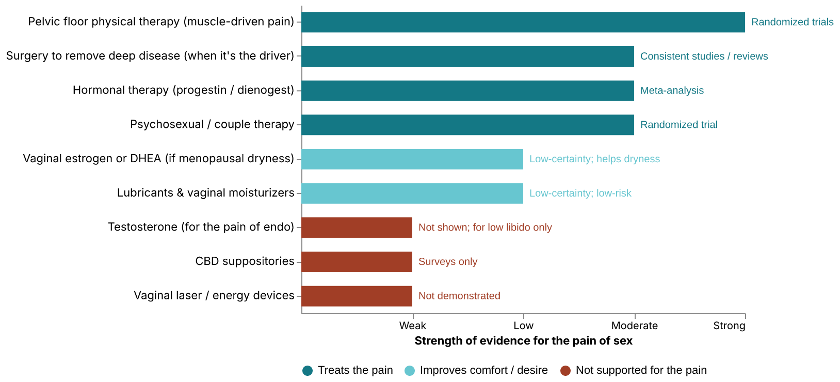
Figure 1. Pelvic floor physical therapy and removing deep disease, when it's the driver, have the strongest evidence for painful sex in endometriosis. Hormonal therapy and psychosexual therapy are solidly supported. Vaginal estrogen or DHEA, lubricants, and moisturizers help comfort, especially with a menopausal component, on lower-certainty evidence. Testosterone, CBD, and vaginal laser aren't shown to treat the pain itself.
3. Treating the Disease: Surgery and Hormones
When deep disease really is the driver, two tools have the best track record.
Surgery. Removing deep endometriosis reliably reduces deep pain with sex. A systematic review of surgical studies found that essentially all of them reported a significant drop in dyspareunia afterward, with better sexual quality of life [4], and studies of deep-disease surgery show real improvement in sexual function [13]. Surgery improves painful sex for many women without guaranteeing it disappears for good, and the goal should be overall sexual wellbeing, not just the pain score [7].
Hormonal therapy. Progestogens are the foundation of hormone therapy in endometriosis whether it be for treating pain with sex or navigating the menopause transition. For the purposes of this article, we will focus on progestins.
Dienogest. A meta-analysis found dienogest improved dyspareunia compared with placebo [14], and in deep rectovaginal disease it lowers deep pain, though some women are left with moderate symptoms [15]. Dienogest as a stand-alone drug is used mainly outside the U.S. In the United States, dienogest is combined with estradiol in a birth-control pill.
Norethindrone acetate. Norethindrone acetate (NETA; Aygestin) deserves special mention because it is one of the most widely prescribed progestins for endometriosis in the United States and has some of the strongest evidence for improving deep dyspareunia. Multiple studies of women with rectovaginal and deeply infiltrating endometriosis have shown significant reductions in pain during intercourse, chronic pelvic pain, and painful bowel movements, with benefits maintained during long-term therapy of up to five years. In women with severe deep dyspareunia after previous surgery, low-dose continuous NETA achieved improvements in pain during intercourse, sexual functioning, quality of life, and overall patient satisfaction that were comparable to repeat conservative surgery, while avoiding another operation. Like all hormonal therapies, NETA suppresses the activity of endometriosis rather than removing the disease itself, making it an excellent option for women wishing to postpone or avoid surgery. Breakthrough bleeding, mood changes, weight gain, acne, and other progestin-related side effects may limit long-term use in some patients, but its low cost, extensive clinical experience, and favorable efficacy profile continue to make it one of the cornerstone medical treatments for endometriosis-associated pain, including deep dyspareunia [16, 17, 18, 19].
Drospirenone. Drospirenone (marketed as Slynd), taken continuously, is the one progestin-only pill that reliably suppresses ovulation. Carrying no estrogen component also avoids the theoretical concern of an estrogen-driven flare, which is the same logic behind avoiding combined pills in some patients. The catch is that the clinical evidence specific to painful sex is thin. The main efficacy data is a retrospective chart review of 61 adolescents, most with stage I disease, on continuous drospirenone-only for endometriosis: 67% reported less pain, but the outcome tracked was pelvic pain and dysmenorrhea, not dyspareunia specifically, and a quarter of patients discontinued for breakthrough bleeding [29].
At the table: Antonio & Magen
Antonio: When there's a tender nodule I can feel on exam and see on imaging, and it lines up exactly with where she hurts, I'll make the case for excision. That's the scenario where surgery earns its keep.
Magen: No argument there, but I'd want her to have tried, or to be doing alongside it, the muscle and nervous-system work. I've seen women sent straight to a second or third surgery when the disease wasn't really the problem anymore. Surgery for a lesion, yes. Surgery as a reflex for any pain with sex, no.
Both of us: Repeat surgery for pain that lives mostly in the muscles and nervous system usually disappoints. That's our clearest shared line.
Magen: Slynd has quickly become a favored hormonal therapy in endometriosis for me. It suppresses ovulation, doesn’t have an estrogen component, and while the data on pain with sex is currently lacking, clinically I see improvement.
Surgery and progestins are legitimate, evidence-backed tools when the disease is the driver. If your pain is mostly muscle- or nerve-based, they may help less than you'd hope, which is the whole reason for the next section.
4. Treating the Muscles: the Strongest Common Ground
If there's one place the surgeon and the sexual-medicine specialist link arms without hesitation, it's here: pelvic floor physical therapy.
Deep disease is associated with an over-tight pelvic floor, and targeted physical therapy measurably relaxes those muscles [5]. In a randomized trial of women with deep endometriosis and entry pain, pelvic floor physiotherapy improved superficial dyspareunia and pelvic pain and helped the muscles relax, with high patient satisfaction [6]. A systematic review and meta-analysis found that physical-therapy approaches significantly reduced both dyspareunia and pelvic pain [20]. For entry pain specifically, a randomized trial found multimodal physical therapy more effective than topical lidocaine [21].
One caveat: in that endometriosis trial, physiotherapy's effect on urinary, bowel, and overall sexual function scores was less clear than its effect on the pain and muscle tension themselves [6]. So, it isn't magic. But it's low-risk, it treats a layer nothing else touches, and it's genuinely evidence-based.
At the table: Antonio & Magen
Magen: This is foundational for most entry pain and for a guarded pelvic floor. A skilled pelvic floor PT can do things no pill and no scalpel can.
Antonio: I'll say something surgeons don't say often enough: physical therapy has kept some of my patients out of the operating room and made the surgeries I do perform work better. We agree on this one without an asterisk.
If painful sex is on your list, ask for a referral to a pelvic floor physical therapist, ideally one experienced with endometriosis.
5. The Hormone-and-Comfort Layer: Real Help, and Where It's Oversold
Some women with endometriosis, especially those in perimenopause, in surgical menopause, or on medications that lower estrogen, develop vaginal dryness and tissue thinning: genitourinary syndrome of menopause, or GSM. It’s the most readily treatable driver of painful sex, and it's a big part of Magen's daily practice [2].
What has evidence: vaginal estrogen, vaginal DHEA, and vaginal moisturizers can improve dryness and, to a lesser degree, the pain of sex when dryness is the cause [22]. In a head-to-head randomized trial, both vaginal DHEA and vaginal estrogen improved dyspareunia after menopause, with DHEA doing a bit better for severe pain [23]. Lubricants and moisturizers are cheap, safe, and reasonable on lower-certainty evidence: one randomized trial found a lubricant improved women's sexual wellbeing, though the overall evidence isn't strong enough for firm conclusions [24].
Where the marketing gets ahead of the science. We sometimes pull in different directions here, so we'll be direct.
Testosterone. The global consensus of menopause and sexual-medicine societies is clear: the only globally agreed upon use of testosterone in women is for low sexual desire (HSDD) in postmenopausal women, where the effect is moderate [25]. There isn't enough evidence to recommend it for any other symptom, including the pain of endometriosis [26]. A large government evidence review reached the same conclusion for GSM: the evidence doesn't demonstrate that vaginal or systemic testosterone works for those symptoms [22]. The same consensus recommends against compounded testosterone, pellets, and injections that more often push levels above the normal female range [25].
Vaginal laser and energy devices. The evidence doesn't demonstrate that they work for these symptoms [22].
CBD suppositories. Interest is high, but the data are essentially survey reports, women saying products helped, with no trial strong enough to support a real recommendation for gynecologic pain [26].
At the table: Antonio & Magen
Magen: Testosterone changed the game for some of my patients whose desire had flatlined, and I'll defend prescribing it, done properly, with a standardized product and blood levels kept in range, for the right woman. Additionally, when hormone-mediated entry pain or vestibulodynia are suspected, topical vaginal testosterone cream can be a game-changer.
Antonio: That's exactly the line I care about. If a woman's problem is desire, that's Magen's wheelhouse and the evidence supports her. But if she's here because sex hurts, testosterone isn't the treatment, and I worry when I see it, or lasers, or CBD, sold as a cure for pain they've never been shown to fix.
Both of us: Low libido and painful sex overlap, but they're not the same complaint. Treat desire as desire, treat pain as pain, and be suspicious of anything marketed as fixing both.
If dryness is part of your picture, vaginal estrogen or DHEA plus lubricants and moisturizers are sensible and safe. Testosterone, a vaginal laser, or a CBD product specifically to stop pain with sex, are currently lacking sufficient evidence to support first-line use.
6. The Whole Person: Intimacy, Anxiety, and the Nervous System
Pain with sex doesn't stay in the pelvis. It teaches the body to anticipate pain, which tightens the muscles, which creates more pain, and it strains intimacy and mood. Treating that loop is part of the medicine, not an add-on.
Psychosexual and couple-based therapy has real evidence. In a randomized trial for provoked entry pain, a structured cognitive-behavioral couple therapy outperformed topical lidocaine on more dimensions of the problem [27]. Approaches like Sensate Focus, a step-by-step way of rebuilding touch and intimacy without pressure, are part of certified sexual-medicine practice and address what no lesion or muscle explains [2]. Because the best outcomes come from combining tools, endometriosis care increasingly leans on a multidisciplinary team: surgeon, physical therapist, and sexual-medicine or mental-health support together [7, 28].
If pain has made you dread or avoid sex, that reaction is your nervous system doing its job, and it's treatable. Adding a pelvic floor PT, a psychosexual therapist, or both to your team doesn't mean the pain is in your head. It means treating the layers surgery and hormones can't reach.
Our Take: Match the Treatment to the Layer
We come from different chairs, and we landed in the same place. Painful sex in endometriosis is a stack: disease, muscles, nervous system, hormones, and intimacy. The winning strategy is to figure out which layers are driving your pain and treat those, in a sensible order.
When a tender deep lesion lines up with the pain, excision and progestins earn their place. When the muscles are guarding, pelvic floor physical therapy is the strongest, lowest-risk tool available. When the nervous system has turned up the volume, or when avoidance and anxiety have set in, psychosexual therapy belongs in the plan. When dryness is real, vaginal estrogen or DHEA and simple lubricants help. And when someone is selling testosterone, lasers, or CBD as a cure for the pain of sex, the honest answer is that the evidence isn't there, even though testosterone has a real, narrower role for low desire.
The most common failure we both see is a woman treated for only one layer, usually whichever one matches the specialist in front of her, while the layers actually driving her pain go untouched. You deserve the whole map.
A Note on Pleasure
Somewhere in all the talk of lesions and muscle tone, it's easy to lose the point: you're allowed to want sex that doesn't hurt, and to want it to feel good. Painful sex isn't a tax you pay for having endometriosis, and it isn't something to push through. It's a symptom, a common, well-studied, treatable one, and wanting it fixed is health, not vanity. If a clinician makes you feel otherwise, find a different clinician. Don't stop asking.
Relevant Research:
About | Discover Holistic Solutions, Mystic Valley Sexual Wellness. mysticvalleysexualwellness.com/about
Yong P (2017) Deep Dyspareunia in Endometriosis: A Proposed Framework Based on Pain Mechanisms and Genito-Pelvic Pain Penetration Disorder. Sexual Medicine Reviews. doi.org/10.1016/j.sxmr.2017.06.005
Fritzer N, Tammaa A, Salzer H, Hudelist G (2014) Dyspareunia and quality of sex life after surgical excision of endometriosis: a systematic review. European Journal of Obstetrics, Gynecology, and Reproductive Biology. doi.org/10.1016/j.ejogrb.2013.10.032
Forno SD, Arena A, Pellizzone V, et al (2021) Assessment of levator hiatal area using 3D/4D transperineal ultrasound in women with deep infiltrating endometriosis and superficial dyspareunia treated with pelvic floor muscle physiotherapy: randomized controlled trial. Ultrasound in Obstetrics and Gynecology. doi.org/10.1002/uog.23590
Forno SD, Cocchi L, Arena A, et al (2023) Effects of Pelvic Floor Muscle Physiotherapy on Urinary, Bowel, and Sexual Functions in Women with Deep Infiltrating Endometriosis: A Randomized Controlled Trial. Medicina. doi.org/10.3390/medicina60010067
Barbara G, Facchin F, Meschia M, et al (2016/2017) When love hurts: a systematic review on the effects of endometriosis surgical and pharmacological treatments on female sexual functioning. Acta Obstetricia et Gynecologica Scandinavica. doi.org/10.1111/aogs.13031
McNamara HC, Frawley H, Donoghue J, et al (2021) Peripheral, Central, and Cross Sensitization in Endometriosis-Associated Pain and Comorbid Pain Syndromes. Frontiers in Reproductive Health. doi.org/10.3389/frph.2021.729642
Williams C, Hoang L, Yosef A, et al (2016) Nerve Bundles and Deep Dyspareunia in Endometriosis. Reproductive Sciences. doi.org/10.1177/1933719115623644
Orr N, Noga H, Williams C, et al (2018) Deep Dyspareunia in Endometriosis: Role of the Bladder and Pelvic Floor. Journal of Sexual Medicine. doi.org/10.1016/j.jsxm.2018.06.007
Orr N, Wahl K, Noga H, et al (2020) Phenotyping Sexual Pain in Endometriosis Using the Central Sensitization Inventory. Journal of Sexual Medicine. doi.org/10.1016/j.jsxm.2019.12.019
Raimondo D, Bertoldo L, Aguzzi A, et al (2026) Central sensitization and hormonal therapy failure for endometriosis-related pain symptoms: a prospective study. Journal of Minimally Invasive Gynecology. doi.org/10.1016/j.jmig.2026.06.028
Cervantes G, Ribeiro PAAG, Tomasi M, et al (2023) Sexual Function of Patients with Deep Endometriosis after Surgical Treatment: A Systematic Review. Revista Brasileira de Ginecologia e Obstetricia. doi.org/10.1055/s-0043-1772596
Sutrisno S, Firdaus WA (2023) Efficacy of Dienogest on Pelvic Pain and Dyspareunia: Comprehensive Meta-Analysis and Systematic Review. Asian Journal of Health Research. doi.org/10.55561/ajhr.v2i1.73
Ferrero S, Maggiore U, Scala C, et al Dienogest in the treatment of rectovaginal endometriosis: effect on deep dyspareunia and sexual function. Fertility and Sterility. [Editorial note: not independently confirmed — verify title, authors, and DOI before publication.]
Vercellini et al., Human Reproduction 2012 – surgery vs. NETA for deep dyspareunia.
Vercellini et al., Human Reproduction 2013 – sexual function and quality of life.
Morotti (Ferrero) et al., Eur J Obstet Gynecol Reprod Biol 2017 – five-year efficacy and acceptability of NETA.
Vercellini et al., Medical Treatments for Endometriosis-Associated Pelvic Pain (review) – summarizes the evidence for NETA and its role as long-term first-line therapy.
Mena-Gonzalez A, Leiros-Rodriguez R, Hernandez-Lucas P (2026) Effectiveness of physical therapy techniques and methods in the management of endometriosis symptoms: A systematic review with meta-analysis. Brazilian Journal of Physical Therapy. doi.org/10.1016/j.bjpt.2026.101620
Morin M, Dumoulin C, Bergeron S, et al (2020) Multimodal physical therapy versus topical lidocaine for provoked vestibulodynia: a prospective, multicentre, randomized trial. American Journal of Obstetrics and Gynecology. doi.org/10.1016/j.ajog.2020.08.038
Agency for Healthcare Research and Quality (AHRQ) (2024) Genitourinary Syndrome of Menopause: A Systematic Review. Comparative Effectiveness Review No. 272. effectivehealthcare.ahrq.gov
Strandberg M, Cockin A, Hirschberg A (2026) Effects of vaginal dehydroepiandrosterone and estradiol on dyspareunia, a symptom of vulvovaginal atrophy in postmenopausal women: a randomized controlled trial. Maturitas. doi.org/10.1016/j.maturitas.2026.108924
Lubricants for the promotion of sexual health and well-being: a systematic review. PMC8942543.
Davis SR, Baber R, Panay N, et al (2019) Global Consensus Position Statement on the Use of Testosterone Therapy for Women. Journal of Clinical Endocrinology & Metabolism. doi.org/10.1210/jc.2019-01603
Medical Cannabis for Gynecologic Pain Conditions: A Systematic Review. PMID 35104069.
Bergeron S, Vaillancourt-Morel M-P, Corsini-Munt S, et al (2021) Cognitive-behavioral couple therapy versus lidocaine for provoked vestibulodynia: A randomized clinical trial. Journal of Consulting and Clinical Psychology. doi.org/10.1037/ccp0000631
Ghaderi F, Bastani P, Hajebrahimi S, et al (2019) Pelvic floor rehabilitation in the treatment of women with dyspareunia: a randomized controlled clinical trial. International Urogynecology Journal. doi.org/10.1007/s00192-019-04019-3
Shim JY, Garbo G, Grimstad FW, Scatoni A, Barrera EP, Boskey ER (2024) Use of the Drospirenone-Only Contraceptive Pill in Adolescents with Endometriosis. Journal of Pediatric and Adolescent Gynecology. doi.org/10.1016/j.jpag.2024.02.003 [Editorial note: retrospective cohort in adolescents; outcome measured was pelvic pain and dysmenorrhea resolution, not dyspareunia specifically.]
