
Anxiety in Midlife
You're in your 40s. You've never been an anxious person.
But lately, a low hum of dread pops up throughout the day: nighttime palpitations, a new fear of driving over bridges or in tunnels, and racing thoughts at 3am. Your provider runs some labs, maybe hands you a prescription for an SSRI, and tells you it's generalized anxiety disorder.
But what if it's not?
The hormone connection few providers understand
During early perimenopause, progesterone sharply declines. Progesterone is a hormone made by the ovaries which regulates mood and sleep, so that sharp decline? It’s not subtle. And it shows up for many women as irritability, anxiety, and sleep disruption.
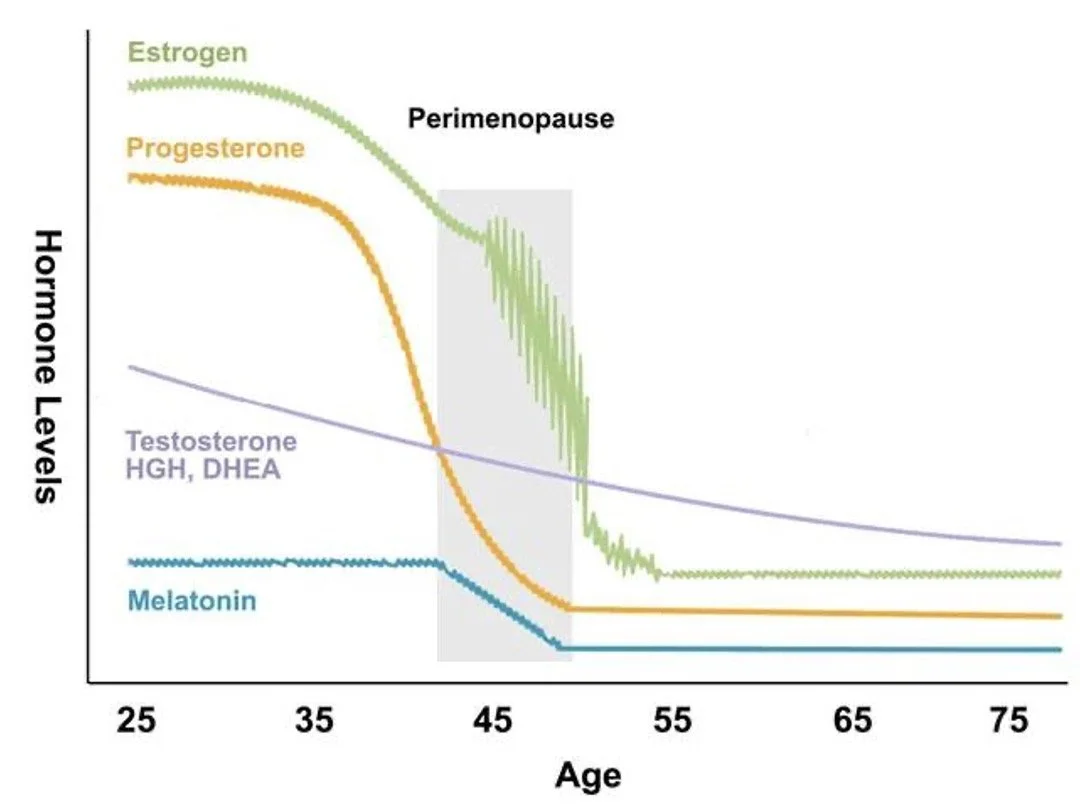
Representation of what hormones do over the course of a woman’s life
Progesterone and the brain
So what’s going on with progesterone, exactly? Your body converts progesterone into a neurosteroid called allopregnanolone, which is one of the most powerful natural activators of GABA-A receptors (the same receptors targeted by anti-anxiety medications like benzodiazepines). In other words, progesterone helps your brain produce its own built-in relaxer.
As perimenopausal cycles become increasingly anovulatory, progesterone production drops. Less progesterone means less allopregnanolone, which means less GABA activation, and less of that background sense of calm you never even knew you had until it was gone.
Why this gets mislabeled
The symptoms of hormone-mediated anxiety (racing thoughts, insomnia, a tight chest, irritability) look identical to generalized anxiety disorder on a standard screening questionnaire. And because most clinicians aren't trained to connect mood symptoms to the menopause transition, the underlying hormonal mechanism often goes unrecognized. Women are too often started on psychiatric medications without anyone asking about their menstrual cycle changes.
What you can do
If you're between 35 and 55 and experiencing new or worsening anxiety alongside irregular periods, night sweats, or sleep disruption, consider talking to your provider about whether your symptoms might be hormonally driven. Menopausal hormone therapy, lifestyle interventions, and targeted approaches can address the underlying cause, not just mask the symptoms.
You're not losing your mind. Your hormones are just changing the rules.
Relevant Research:
Joffe H, de Wit A, Coborn J, et al. Impact of Estradiol Variability and Progesterone on Mood in Perimenopausal Women With Depressive Symptoms. J Clin Endocrinol Metab. 2020.
Brown L, Hunter MS, Chen R, et al. Promoting Good Mental Health Over the Menopause Transition. Lancet. 2024.
Kapur J, Joshi S. Progesterone Modulates Neuronal Excitability Bidirectionally. Neurosci Lett. 2021.
Schüle C, Nothdurfter C, Rupprecht R. The Role of Allopregnanolone in Depression and Anxiety. Prog Neurobiol. 2014.
Committee on Clinical Practice Guidelines–Gynecology. Management of Premenstrual Disorders: ACOG Clinical Practice Guideline No. 7. Obstet Gynecol. 2023.
Li SH, Graham BM. Why Are Women So Vulnerable to Anxiety, Trauma-Related and Stress-Related Disorders? The Potential Role of Sex Hormones. Lancet Psychiatry. 2017.
McElhany KM, Dishman DN, Metcalf CA, Beauchamp JES. Anxiety During Perimenopause: A Qualitative Study of Lived Experiences. Menopause. 2026.
Brown L, Hunter MS, Chen R, et al. Promoting Good Mental Health Over the Menopause Transition. Lancet. 2024.
