
PMDD and Progesterone
If you’re in midlife and have PMDD, you’ve probably been told “stay away from progesterone!” And perhaps based on past experiences with progesterone, you’re in no hurry to go against this advice.
BUT the science behind why progesterone made you miserable during your cycling years is the same science that explains why it might actually still be an option for you.
What is PMDD?
PMDD is not "bad PMS,” and it's not caused by having too much or too little progesterone.
Women with PMDD have completely normal hormone levels. The difference is in how their brains respond to those hormones; specifically, to a progesterone byproduct called allopregnanolone.
In most brains, allopregnanolone acts like a natural sedative. It plugs into the same brain receptors that Valium does (GABA-A receptors) and produces calm.
In PMDD brains, something different happens. At the concentrations your body produces during the luteal phase (the two weeks after ovulation/before your period), allopregnanolone triggers the opposite reaction: anxiety, irritability, depression, and emotional overwhelm. Researchers call this a "paradoxical reaction," and it's the same type of reaction that causes some people to become agitated on benzodiazepines or aggressive after a few drinks.
Can you take progesterone during the menopause transition?
Yes… but the details matter enormously. Here are the three things that make menopause hormone therapy fundamentally different from what your menstrual cycle did to you:
1. Stability
Your menstrual cycle was the problem, not progesterone itself. Every month, your brain was hit with a rapid rise in progesterone after ovulation, followed by a sharp withdrawal before your period. Your brain never got the chance to adapt.
A landmark NIH study proved this directly. Researchers gave women with PMDD continuous, stable doses of bioidentical estrogen (via transdermal patch) and progesterone (via vaginal suppository) after suppressing their ovaries. Symptoms flared during the first month (when hormone levels were changing) but then resolved during months two and three, even with progesterone on board.
The takeaway: once hormone levels stabilize, even PMDD brains adapt and symptoms resolve. Continuous hormone therapy is a completely different physiological scenario than the monthly rollercoaster of the menstrual cycle.
2. Dose matters
In most brains, allopregnanolone works in a straightforward way: more of it means more calm, eventually tipping into sedation at very high levels. But in PMDD-susceptible brains, the response follows an inverted U-shaped curve. At low levels, there's minimal effect. At intermediate levels (the range your body naturally produces during the luteal phase) - that's the danger zone where paradoxical anxiety and dysphoria peak. But at higher levels, the negative mood effect can disappear entirely, and genuine calming can take over.
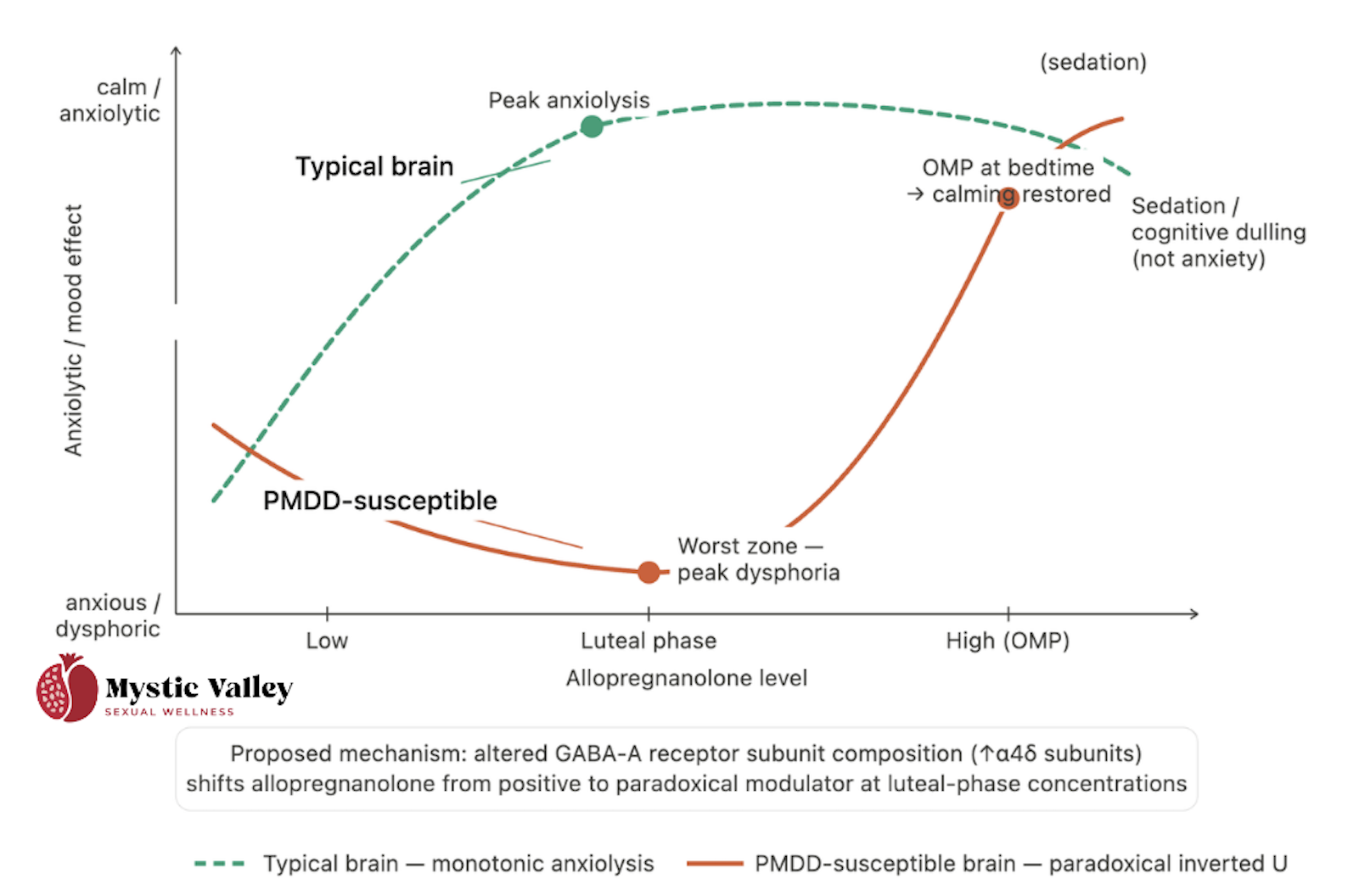
Allopregnanolone and PMDD: the inverted-U curve theory
This graph illustrates the concept. The green dashed line shows how a typical brain responds to rising allopregnanolone: steady calming that eventually tips into sedation. The orange line shows what happens in a PMDD-susceptible brain: at luteal-phase concentrations (the range often produced by 100–200 mg of oral progesterone), mood actually worsens. But at higher concentrations (the range often produced by 300–400 mg) calming is restored.
Here's what this means practically: a standard dose of oral micronized progesterone may produce allopregnanolone levels that land you right in the worst zone, mimicking the very luteal-phase concentrations that made your menstrual cycles unbearable. But a higher dose at bedtime can push allopregnanolone levels above the danger zone and into the genuinely calming range.
3. Oral vs. vaginal
When you take progesterone by mouth, it passes through your liver first. This "first-pass" metabolism converts a large proportion of the progesterone into allopregnanolone and other neurosteroids. Oral progesterone is essentially a prodrug for allopregnanolone: it produces dramatically higher neurosteroid levels compared to vaginal progesterone, even when the resulting progesterone levels in the blood are similar.
Vaginal progesterone bypasses the liver, so it produces substantially lower allopregnanolone levels, but it doesn't eliminate them entirely. Your brain and other tissues have their own enzymes that can convert circulating progesterone into allopregnanolone locally. So vaginal progesterone reduces neurosteroid exposure, but doesn't remove it from the equation, especially at higher doses.
For women with PMDD brains who wish to take progesterone, this creates two distinct strategies:
Strategy A - Push past the danger zone: Use high dose oral micronized progesterone at bedtime. This produces enough allopregnanolone to clear the paradoxical danger zone and reach the genuinely calming, anti-anxiety range.
Strategy B - Reduce neurosteroid exposure: Use vaginal progesterone for endometrial protection. This significantly lowers allopregnanolone production compared to oral dosing, though some conversion still occurs. This may work well for women whose sensitivity falls on the milder end of the spectrum.
What is least likely to work well: standard/low dose oral progesterone. This dose may produce just enough allopregnanolone to land in the danger zone without pushing through it; the worst of both worlds.
The adjustment period
Even with the right dose and route, expect a rough patch when starting progesterone. The NIH study showed that PMDD symptoms emerged during the first month of hormone exposure but resolved by months two and three as the brain adapted to stable levels.
This is critical to understand: feeling worse in the first few weeks doesn't necessarily mean progesterone isn't going to work. It may mean your brain is in the process of adapting. Close monitoring, additional psychiatric/emotional support, and patience during this window (with a provider who understands what's happening) makes all the difference.
Why this matters at menopause specifically
As you enter perimenopause, ovulation becomes erratic. Some months you ovulate, some you don't. Progesterone levels become unpredictable sometimes surging and sometimes absent. For women with PMDD, this means symptoms that are less predictable and harder to manage, along with new mood symptoms driven by estrogen instability. In fact, studies show that women with PMDD are more likely to experience severe perimenopausal symptoms.
When done right, menopause hormone therapy can be especially beneficial for women with PMDD, because these are the women whose brains are most sensitive to the hormonal instability of perimenopause.
The bottom line
If you have PMDD and are entering perimenopause, progesterone is an option. But details matter:
Continuous dosing: to avoid the rise-and-fall pattern that triggered your symptoms
The right dose: high enough to push past the paradoxical danger zone
The right route: oral at a higher dose if you want the neurosteroid calming effect, vaginal if you want to avoid neurosteroid effects
Support through the first month of adaptation
A provider who understands PMDD neurobiology
Your PMDD brain may be wired differently, but it is not broken.
Relevant Research:
Schmidt PJ, Martinez PE, Nieman LK, et al. Premenstrual Dysphoric Disorder Symptoms Following Ovarian Suppression: Triggered by Change in Ovarian Steroid Levels but Not Continuous Stable Levels. American Journal of Psychiatry. 2017;174(10):980-989.
Wei SM, Wakim P, Martinez PE, et al. Differential Effects of Ovarian Steroids in Women With and Without Premenstrual Dysphoric Disorder: A Replication and Extension of Findings. American Journal of Psychiatry. 2025;182(3):257-267.
Bäckström T, Bixo M, Johansson M, et al. Allopregnanolone and Mood Disorders. Progress in Neurobiology. 2014;113:88-94.
Andréen L, Nyberg S, Turkmen S, et al. Sex Steroid Induced Negative Mood May Be Explained by the Paradoxical Effect Mediated by GABAA Modulators. Psychoneuroendocrinology. 2009;34(8):1121-1132.
Bixo M, Johansson M, Timby E, Michalski L, Bäckström T. Effects of GABA Active Steroids in the Female Brain With a Focus on the Premenstrual Dysphoric Disorder. Journal of Neuroendocrinology. 2018;30(2):e12553.
Bixo M, Stiernman L, Bäckström T. Neurosteroids and Premenstrual Dysphoric Disorder. British Journal of Psychiatry. 2025.
Andréen L, Spigset O, Andersson A, Nyberg S, Bäckström T. Pharmacokinetics of Progesterone and Its Metabolites Allopregnanolone and Pregnanolone After Oral Administration of Low-Dose Progesterone. Maturitas. 2006;54(3):238-244.
Piette PCM. The Pharmacodynamics and Safety of Progesterone. Best Practice & Research Clinical Obstetrics & Gynaecology. 2020;69:13-29.
Nahoul K, Dehennin L, Jondet M, Roger M. Profiles of Plasma Estrogens, Progesterone and Their Metabolites After Oral or Vaginal Administration of Estradiol or Progesterone. Maturitas. 1993;16(3):185-202.
Gordon JL, Rubinow DR, Eisenlohr-Moul TA, et al. Efficacy of Transdermal Estradiol and Micronized Progesterone in the Prevention of Depressive Symptoms in the Menopause Transition: A Randomized Clinical Trial. JAMA Psychiatry. 2018;75(2):149-157.
de Lignières B, Dennerstein L, Bäckström T. Influence of Route of Administration on Progesterone Metabolism. Maturitas. 1995;21(3):251-257.
Schumacher M, Mattern C, Ghoumari A, et al. Revisiting the Roles of Progesterone and Allopregnanolone in the Nervous System: Resurgence of the Progesterone Receptors. Progress in Neurobiology. 2014;113:6-39.
Guennoun R, Labombarda F, Gonzalez Deniselle MC, et al. Progesterone and Allopregnanolone in the Central Nervous System: Response to Injury and Implication for Neuroprotection. Journal of Steroid Biochemistry and Molecular Biology. 2015;146:48-61.
