
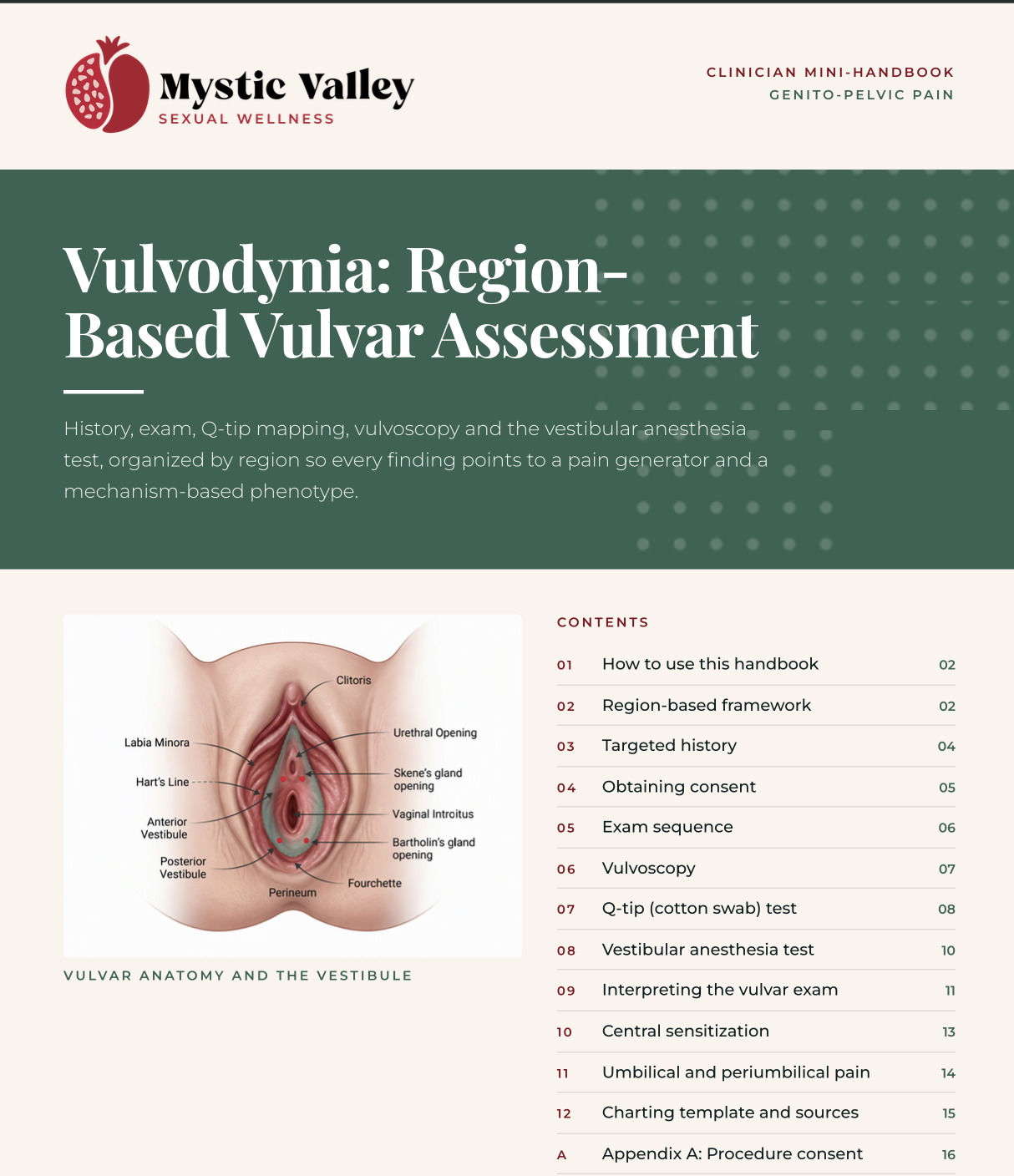
 Image 1 of 1
Vulvodynia: Region-Based Vulvar Assessment, a Clinician Mini-Handbook
A 19-page clinical toolkit that turns a vulvar pain exam into a diagnosis, built for women’s health and sexual medicine practices.
“Vulvodynia” is where too many workups end. This handbook treats it as a starting point. It gives your clinicians one consistent, region-based method for finding the actual pain generator, whether that’s the vestibular tissue, the pelvic floor, the pudendal nerve, the sacral roots or central sensitization. Each finding points to a mechanism-based phenotype and a next step.
What’s inside
The five-region framework: what lives in each region, what it contributes to vulvar pain, and the tool that rules it in or out.
Targeted history: every question paired with what a positive answer points to.
A complete exam sequence: outside-in and least-to-most provocative, with a supply list.
Vulvoscopy guide: what to look for in each area and what it means, including clitoral adhesion grading.
Q-tip mapping: a standardized 8-point vestibular map, technique, and an interpretation table that reads the pain-free sites as carefully as the painful ones.
Vestibular anesthesia test (VAT): a step-by-step protocol and a result-by-result interpretation table.
Pattern-recognition table: exam pattern, matching history, phenotype and confirmatory test for 11 presentations.
Central sensitization: mechanism, clinical signs and management principles.
Umbilical and periumbilical pain: why the umbilicus matters, and how to examine and interpret it.
Charting template: the same skeleton every visit, so progress is measured against a baseline map.
Sample consent forms: procedure consent (vulvoscopy, Q-tip and VAT) and clinical photography consent.
Who it’s for
Women’s health, menopause and sexual medicine practices; OB/GYN, urogynecology and pelvic pain clinics; and practices onboarding new NPs, PAs or physicians who need a shared standard for vulvar pain assessment.
For use by licensed clinicians as an educational and clinical reference. It does not replace clinical judgment. Sample consent forms should be reviewed against your state’s requirements and your institution’s policies before use.